Have you ever felt a poem, not just read it? I’m not talking about emotion, though that’s part of it. I mean the physical sensation of your eyes tracing the path of words down a page, the way lines curve or spike, and how the blank space itself seems to speak. This is the realm of shapes for poems, a fascinating intersection of visual art and literary craft where the poem’s form is its meaning.
Forget the strict left-justified block of text for a moment. Imagine a poem about a waterfall where the words cascade down the page in a shimmering column. Picture a lament for a lost love where the lines huddle into the fragile outline of a shattered vase. This is more than a gimmick; it’s a powerful, ancient technique that engages the reader on a deeply intuitive level. The right visual configuration can make your message unforgettable.
In this deep dive, we’ll explore 15 potent shapes for poems, from historical curiosities to modern marvels. You’ll learn not just what they are, but why they work and how you can harness them in your own writing. This is about giving your words a body, a silhouette, a physical presence in the world.
Table of Contents
- What Are Poetic Shapes? Beyond the Straight Line
- A Brief History: From Sacred Altars to Coffeehouse Revolutions
- The Core Philosophy: When Form IS Content
- The Ultimate 15 Shapes for Poems to Master
- The Silhouette Poem
- The Calligram
- The Diamante
- The Concrete Cascade
- The Found Object Poem
- The Pattern Poem (Technopaignia)
- The Twin & Mirror Poem
- The Spiral
- The Column & Pillar
- The Step or Ladder Poem
- The Braided Poem
- The Circular Poem (Carmen Figuratum)
- The Distributed Poem
- The Code & Algorithmic Shape
- The Erasure Shadow
- How to Choose the Right Shape for Your Poem
- A Step-by-Step Case Study: Crafting a Leaf Silhouette Poem
- Modern Tools: Software and Tips for Digital Shape Poetry
- Beyond the Page: Performance and Installation
- Conclusion: Giving Your Words a Home
What Are Poetic Shapes? Beyond the Straight Line
Let’s start simply. When we talk about shapes for poems, we’re referring to the intentional, meaningful arrangement of words, letters, and white space on a page (or screen) to create a visual image that complements, enhances, or becomes the poem’s subject.
It’s visual rhetoric. A poem about confinement might be boxed in by a solid border. A poem about freedom might scatter its phrases like dandelion seeds. These are deliberate shapes for poems that guide the reader’s experience before they’ve even absorbed a single word. It’s a pre-verbal communication, a setting of the stage.
A Brief History: From Sacred Altars to Coffeehouse Revolutions
This isn’t some trendy, Instagram-era invention. The use of shapes for poems is ancient. In the 3rd century BCE, Greek poets like Simmias of Rhodes wrote pattern poems (technopaignia) in the shapes of an axe, wings, and an egg. These were often seen as scholarly puzzles or devotional objects. Later, in the 16th and 17th centuries, “figure poems” shaped like crosses, altars, and hearts were popular in Europe, marrying religious devotion with visual artistry.
The movement we most associate with this form today—concrete poetry—exploded in the 1950s and 60s. Poets like Eugen Gomringer (Switzerland) and the Noigandres group (Brazil) declared the poem to be a “visual-ideographic structure.” For them, the poem was an object in itself. This was a radical break from purely lyrical expression, influenced by modern art movements like Constructivism. They proved that the most effective shapes for poems could be stark, abstract, and typographically bold.
The Core Philosophy: When Form IS Content
The central tenet of working with shapes for poems is the inseparability of form and content. In a traditional sonnet, the 14-line structure creates a specific rhythm and argumentative turn. In visual poetry, the shape is that turn.
- Reinforcement: A poem about a tree in the shape of a tree reinforces the subject literally and beautifully.
- Irony & Contrast: A poem about chaos in the shape of a perfect circle creates a powerful, unsettling dissonance.
- Pacing & Movement: A winding, spiral shape forces the reader to slow down, to follow the path, mimicking the poem’s thematic journey.
- Spatial Metaphor: The use of space—distance between words, gaps, alignments—becomes a metaphor for connection, isolation, or fragmentation.
Choosing among different shapes for poems is therefore one of the most critical creative decisions you can make. It’s architecture for your emotions.
The Ultimate 15 Shapes for Poems to Master
Here is your practical toolkit. These 15 forms represent the most powerful and versatile shapes for poems you can use.
1. The Silhouette Poem
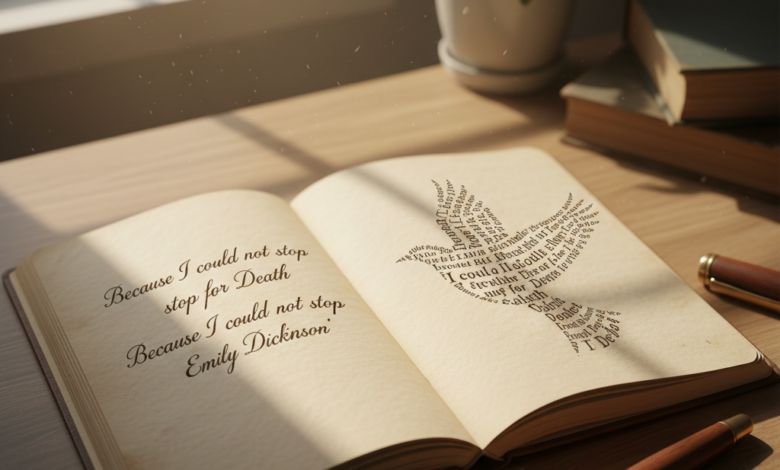
This is the most recognizable type. The text is arranged to fill the outline of a recognizable object or symbol. The subject of the poem and the shape are directly linked (e.g., a poem about a cat in the shape of a cat). It’s immediate, accessible, and visually striking. These shapes for poems are perfect for themes of identity, nature, and tangible objects.
2. The Calligram
Pioneered by Apollinaire in the early 20th century, a calligram uses the text itself to draw the image. The thickness, curvature, and placement of the letters form the lines of the drawing. A famous example is his poem “Il Pleut” (“It’s Raining”), where the words fall down the page in diagonal streams like rain. It’s a painterly approach to shapes for poems.
3. The Diamante
A diamond-shaped poem with a strict, formulaic structure (Noun, 2 Adjectives, 3 -ing words, 4 nouns, 3 -ing words, 2 adjectives, Noun) that creates a diamond on the page. It often contrasts two opposite subjects. It’s a great entry point for students and a wonderful exercise in concise, structured imagery.
4. The Concrete Cascade
Words or phrases are arranged in a freeform, often vertical or diagonal flow that suggests movement—falling, flowing, drifting. It’s less about a fixed silhouette and more about capturing motion. Think of words tumbling like water or leaves. These fluid shapes for poems evoke change, time, and natural forces.
5. The Found Object Poem
The shape is dictated by a physical, non-linguistic object. A poem about a city might be arranged using a street map as a guide. A poem about a memory might be written within the outline of an old photograph. The found object provides the scaffold, making the process of discovering shapes for poems a collaborative one with the world.
6. The Pattern Poem (Technopaignia)
The ancient Greek precursor. The poem follows a rigorous visual and syllabic pattern to create a shape, often symmetrical. It’s as much a mathematical puzzle as a poetic one, showing how early writers experimented with shapes for poems as intellectual and devotional art.
7. The Twin & Mirror Poem
The poem is split into two symmetrical columns or shapes that reflect each other, often presenting a dialogue, a contrast, or a unified whole from two perspectives. The space between them becomes charged with meaning. It’s a profound shape for exploring duality, relationship, and reflection.
8. The Spiral
The text coils inward or outward from a central point. This shape for a poem can represent obsession, introspection, a journey to the core or expansion outward, cycles, and hypnotic states. The reading experience is inherently meditative.
9. The Column & Pillar
A strong, vertical block of text, but one where the width and justification are manipulated to suggest stability, growth, or imprisonment. A widening column might suggest a tree trunk; a narrow, rigid one might suggest a cell bar. It’s a study in verticality among shapes for poems.
10. The Step or Ladder Poem
Lines are indented progressively to create a staircase effect. This can imply ascent, descent, gradual change, or a slow reveal. It’s a simple but incredibly effective way to control pacing and create a sense of climbing through the poem’s ideas.
11. The Braided Poem
Two or more thematic strands (different fonts, colors, or columns of text) intertwine visually on the page, like braided hair. The reader must choose a path or read them simultaneously, experiencing the interweaving of narratives or voices. These complex shapes for poems represent entanglement and unity.
12. The Circular Poem (Carmen Figuratum)
The text forms a perfect circle, with no clear beginning or end. This embodies cyclical concepts: seasons, life and death, eternal return. It can also be read as a symbol of unity and completeness. The challenge is crafting language that sustains this endless loop.
13. The Distributed Poem
The words or phrases are scattered across the page, connected perhaps by faint lines, arrows, or simply spatial proximity. It mimics thought clouds, constellations, or fragmented memories. This approach to shapes for poems rejects linear narrative for a more experiential, map-like reading.
14. The Code & Algorithmic Shape
The shape is generated by a rule or code. For example, each word’s font size is determined by its emotional valence, or its placement is dictated by a mathematical sequence. This creates organic, unexpected shapes for poems that blend logic and creativity, often revealing patterns invisible to the conscious mind.
15. The Erasure Shadow
The poem is created by erasing words from an existing text (a newspaper page, a manual), but the resulting “negative space” poem is presented within the ghost of the original document’s shape. The block of grayed-out text forms the canvas, making the new poem a spectral presence. It’s a powerful shape for poems about history, loss, and reclamation.
How to Choose the Right Shape for Your Poem
Not every poem needs a visual shape, and forcing it can feel contrived. Ask yourself these questions:
- What is the poem’s core physical metaphor? (Is it falling, growing, breaking, circling?)
- What object, symbol, or feeling is central to the piece?
- Do I want to reinforce or contrast with the text’s meaning?
- What experience do I want the reader to have? (Slow, fast, disoriented, comforted?)
Start with a strong draft of the poem, then sketch. Doodle in the margins. Let the words suggest their own container. The most resonant shapes for poems feel inevitable, not applied.
A Step-by-Step Case Study: Crafting a Leaf Silhouette Poem
Let’s make one together. Imagine a short poem about an autumn leaf letting go.
- Write the Core Text: “I clung / to the branch / through summer’s green boast / and the storm’s twist. / Now I release / to the updraft’s whisper, / a brief, golden coast / in the sun’s mist.”
- Identify the Key Shape: A single, simple maple leaf.
- Sketch & Map: Draw a leaf outline on paper. Mentally map parts of the poem to parts of the leaf. “I clung” might anchor the stem. “Golden coast” might fill a broad lobe.
- Arrange & Adjust: Using a word processor or by hand, start placing the phrases. You may need to edit the text—add or remove words, break lines differently—to fit the visual. This interplay is where the magic happens; the shape edits the poem.
- Refine: Play with font, spacing, and alignment. Should “the storm’s twist” curve along a serrated edge? The final piece is a unified artifact where the text and the silhouette of the leaf are one.
Modern Tools: Software and Tips for Digital Shape Poetry
You don’t need to be a graphic designer. Use what you have:
- Microsoft Word/Google Docs: Text boxes, WordArt, and careful spacing are your friends.
- Canva or Adobe Express: User-friendly drag-and-drop interfaces with shape tools.
- Typography Generators: Online tools that let you warp text to paths.
- Basic Code (HTML/CSS): For the adventurous, using
shape-outsideandclip-pathproperties can create dynamic, web-native shapes for poems.
The key is patience and iteration. Zoom in, adjust pixel by pixel if you must.
Beyond the Page: Performance and Installation
Shapes for poems aren’t confined to paper. Poets project text onto buildings in specific patterns. They choreograph performers to hold words on cards, forming shapes for an audience. They carve poems into sand or arrange stones in a field. The principle remains: the spatial arrangement of language creates meaning in three-dimensional space. This expands the concept of shapes for poems into the realm of experience.
Conclusion: Giving Your Words a Home
Exploring shapes for poems is more than a formal exercise; it’s a way of thinking more holistically about communication. It asks us to consider how our words occupy space, how they look to a stranger, how they feel in the hand and the eye. In a digital age saturated with plain text, a poem with a thoughtful, intentional shape is a radical act of attention.
It says: These words have a body. They have a place. Look at them, truly look, and then begin to read.
So, grab your next draft. Don’t just center it on the page. Ask it what it wants to be. Sketch a spiral, a pillar, a scattering of stars. Discover the unique, powerful shapes for poems that only your words can call home. The blank page isn’t just a backdrop; it’s your first and most collaborative material. Use it.